






Fla’s Slaughter and Hulk’s Farewell at Galo
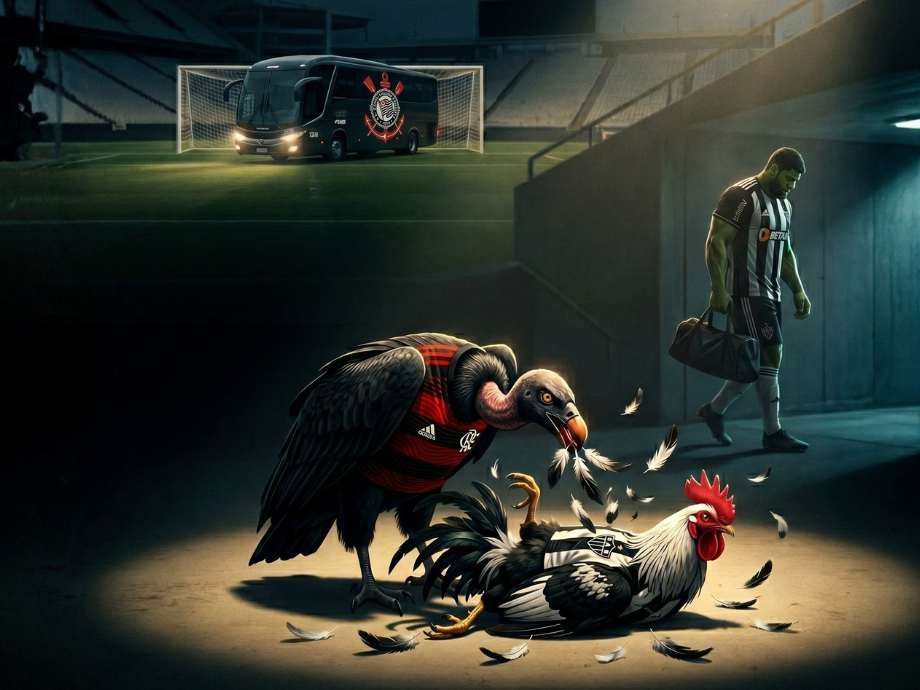
Striker Hulk is virtually out of Atlético-MG after being cut from the derby against Flamengo due to an "irrefutable proposal" from the domestic market. This move prevented the idol from completing seven matches, which would have barred him from switching clubs within Série A. Simultaneously, Leonardo Jardim’s Flamengo orchestrated a tactical massacre at the Arena MRV, delivering a 4-0 thrashing that humiliated the opponent in their own home and solidified the Rubro-Negro as the most efficient team in the country in 2026.
Why did Hulk leave Atlético-MG?
The news of Hulk’s imminent departure from Atlético-MG hit the Brazilian sports scene like a bombshell this Sunday afternoon, April 26, 2026. The striker, who became the victorious face of the Galo project in recent years, was removed from the squad list for the clash against Flamengo in the Arena MRV locker rooms. The official reason, confirmed by the board, was a substantial inquiry from another Série A club, requiring an immediate strategic maneuver: preventing the number 7 from completing his seventh match in the 2026 Brazilian Championship. Under current regulations, had he stepped onto the pitch, Hulk would be legally barred from defending another team in the same edition of the competition, nullifying any advantageous financial negotiation for Galo.
Behind the scenes, signs of wear and tear had already been signaled by the athlete himself in enigmatic statements. Hulk revealed the existence of old "financial pending issues" with the club, despite nominal salaries being up to date. The player expressed a deep sense of disrespect in meetings with the top brass, mentioning that in January 2026, he had already attempted a transfer to Fluminense, which was blocked by last-minute demands from the board. The relationship with Argentine coach Eduardo Domínguez also reached a breaking point; the manager publicly criticized the squad's "lack of commitment," which Hulk vehemently countered by citing GPS data proving exhaustive workloads and high physical intensity in training and matches.
Hulk's departure is not just an irreparable technical loss, but the symbolic end of a golden era. The striker accumulated impressive numbers: 309 games, 140 goals, and 56 assists, along with five state titles, one Copa do Brasil, one Brazilian Championship, and one Supercopa. For the "Old School Fan" (Homem Raiz), seeing an idol of this caliber traded to a direct rival in the midst of a technical crisis is proof that fan passion matters little when the cash flow of SAFs (Football Corporations) is under pressure. Speculation suggests his likely destination is Palmeiras, seeking a heavyweight replacement for the Libertadores knockout stages, or a triumphant return to Rio de Janeiro.
The Flamengo Massacre at Arena MRV: Tactics and Humiliation
While Atlético-MG dealt with the grief of losing their captain, Leonardo Jardim’s Flamengo took the field to star in a "supreme humiliation." The 4-0 victory reflected not just the scoreline, but absolute territorial and psychological dominance. The Rubro-Negro side, currently second in the league, demonstrated why they are
considered the owners of the "best football in recent rounds," presenting a volume of play that turned the first half into a true technical slaughter.
The rout began early, at the 7-minute mark, when Samuel Lino sped down the left and served Pedro, who simply tapped it into the open net. The second goal was an individual masterpiece by Ecuadorian Gonzalo Plata; the striker received the ball in the center circle, sprinted past three markers (Pascini, Cuello, and Vitor Hugo), and finished precisely into the corner of goalkeeper Everson. Arrascaeta, playing with the tactical intelligence of a veteran center-forward, rose higher than the defense to head in a cross from Varela, sealing the 3-0 lead still in the first half. The scoring was closed again by Pedro, following a pinpoint assist from Luiz Araújo—a goal validated by VAR after an initial linesman error.
Long-term analysis shows that Flamengo has made Atlético-MG a "regular customer" (freguês) in their own home. In the last four years, the Rubro-Negro has won three times on Minas Gerais soil in the Brasileirão, in addition to decisive victories in the Copa do Brasil. Galo, which has managed to beat rival Cruzeiro at the Arena MRV, still doesn't know what it's like to defeat Flamengo in its new stadium, a mark that deeply bothers the fans and exposes the fragility of the current project under Eduardo Domínguez.
Fernando Diniz’s Corinthians: From the Relegation Zone to an Impenetrable Fortress
One of the biggest surprises of this 13th round was the confirmation of Corinthians' tactical metamorphosis. Traditionally known for "suffering" and exposure to errors, the 2026 Timão, under the baton of Fernando Diniz, has transformed into a solid defensive unit—an "impenetrable fortress." The team reached the impressive milestone of six consecutive games without conceding a goal, a statistic that challenges Diniz's historical reputation as a coach who neglects the backline in favor of possession.
The 1-0 victory over Vasco, achieved at the Neo Química Arena this Sunday, was the symbol of this new phase. The goal was scored by full-back Matheus Bidu in the first half. However, what made the result valuable was the resilience: Corinthians played the entire second half with one man down after André was sent off for a hard tackle. Even with a numerical disadvantage, the defensive system did not yield, securing Diniz's first victory in the competition and pulling the club out of the relegation zone. This evolution is a balm for the Corinthians "Old School Fan," who values grit and a well-positioned defense over technical acrobatics. Diniz celebrated the system, emphasizing that solidity allowed the team to win again after an agonizing nine-round drought.
Roger Machado and São Paulo: Crisis at Morumbis
While their rival celebrates, São Paulo lives an agonizing paradox. The team wins, but the atmosphere is like a funeral. Coach Roger Machado has become the epicenter of unprecedented hostility from the Tricolor fans. On April 21, after a slim 1-0 victory over Juventude in the Copa do Brasil, the coach was targeted with deafening boos and insults as he headed to the Morumbis locker room. A "fruit of cowardice," although Roger's work is inconsistent, the attacks have crossed the line of sporting debate.
The dissatisfaction of the São Paulo "Old School Fan" lies in Roger's reactive style. The team was harshly criticized for its posture in the comeback defeat to Vasco on April 18, where the team "only defended" and gave up attacking even with the pieces to do so. Furthermore, the excessive dependence on individual flashes and the inefficiency of players like Calleri—who recently wasted clear chances and a decisive penalty—increase the pressure on the commander. Roger Machado vented in a press conference, stating that the external environment is negatively impacting the players' confidence. For him, the fan division creates a polarization that harms São Paulo's pursuit of titles in 2026.
Brazil National Team 2026: Vampeta the "Hater" and the "Brasa" Jersey Controversy
Preparation for the 2026 World Cup has not escaped the controversies that men love to discuss at the bar counter. Coach Carlo Ancelotti confirmed he will announce the 26-man squad list on May 18. However, the mood of national unity was shaken by statements from Vampeta. The 2002 World Champion categorically stated to Jovem Pan radio that he is not rooting for Brazil to win the Hexa (sixth title). Vampeta's motivation is purely linked to legacy: he fears that if a new generation wins, his will be forgotten.
Added to this, the CBF faces massive rejection over the National Team's new official uniform. In an attempt to modernize the brand to attract Gen Z, the word "Brasil" was replaced by "Brasa" on the chest. The change was classified by traditional fans and columnists as a "preppy" (sapatênis) term—forced slang that strips away national identity in favor of empty marketing. For the "Old School Fan," the yellow jersey is sacred, and introducing ephemeral nicknames is seen as a disrespect to the history of the only five-time champion.
On the technical side, Ancelotti is dealing with concerns surrounding Chelsea's starlet Estêvão, who suffered a grade 4 muscle injury and risks being cut from the World Cup. Names like Gabriel Sara and Antony are on the radar to fill this potential void. Neymar also remains a point of contention.
Série A Results: Brasileirão 2026 Round 13
Below, we’ve compiled the hottest results from the last three days, with the necessary "venom" for the reader who doesn't accept coach excuses.
The current standings show Palmeiras in the isolated lead with 32 points, closely followed by Flamengo (26 points and a game in hand) and Fluminense (26 points). At the bottom, the struggle for survival involves traditional teams like Atlético-MG and Santos, who are unable to string together a winning streak.
Questions the "Old School Fan" Asks (FAQ)
Why didn't Hulk play the derby if he was at the Arena MRV? The player was cut minutes before the opening whistle to preserve his transfer status. Since he has played 12 matches in the championship, if he played the 13th (which was ironically Round 13), he could no longer transfer to another Série A club this year. The board preferred not to risk the sale.
Has Diniz's Corinthians become a "park the bus" team? It's not exactly "parking the bus," it's balance. Diniz understood that to get out of the relegation zone, he needed to stop conceding silly goals. Six games without conceding is a miracle for those who know the coach's history. The "Old School Fan" appreciates the solidity.
Will Neymar be a starter in the 2026 World Cup? That's the million-dollar question. Carlo Ancelotti likes his football, but external pressure and inconsistent performances weigh heavily. Analysts believe that, emotionally, he could be a burden if he isn't 100% focused on the pitch.
Conclusion
Brazilian football in 2026 is a chessboard played with the rules of the financial market. Flamengo's massacre over Atlético-MG wasn't just a result on the field, but a reality check for an organized club against a project lost in debt and internal disagreements. Hulk's imminent departure marks the end of romanticism at Galo, while Diniz's Corinthians proves that even the most stubborn can learn to defend.
For the Bella da Semana reader, the message is clear: "Old School" football still breathes in the grit of a 1-0 win with a man down, but the future belongs to those who know how to manage the locker room and the accounts. Keep an eye on the May 18th call-up, and in the meantime, enjoy the peladas—on and off the field—because, as the saying goes, "the game isn't over until the whistle blows," but the controversies last all week long.
Author : Emerson Gonçalves
Posted in: 04/27/2026
Last modified: 09/14/2026
0 comments